
1 November 2026
Can Making Together Help People Feel Connected?
By OpenClip
Research on knitting and social creative groups suggests regular shared making may support contact and belonging, while important limits remain.
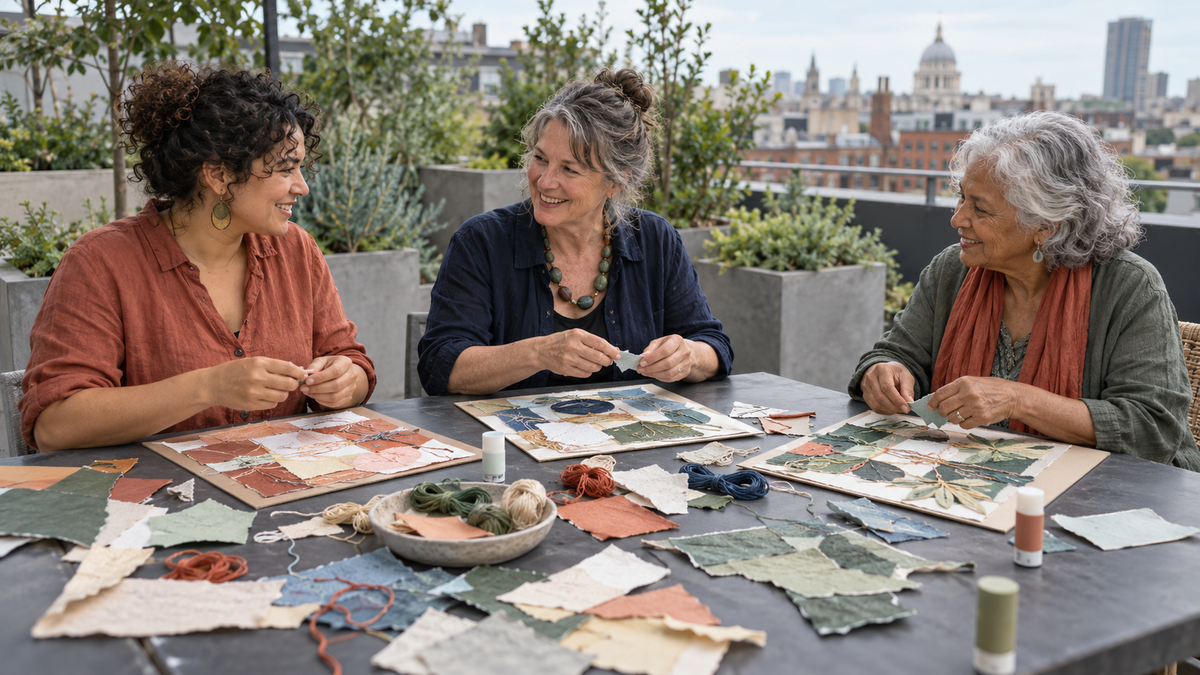
Making alongside other people can create an easy reason to meet, talk and share attention, but research does not show that every craft group automatically builds close relationships. Studies of knitting and social creative groups suggest that regular participation may support contact and belonging for some participants. The practical ingredients appear to include choice, repetition, shared activity and enough room for conversation.
What has actually been studied?
One international online survey collected responses from 3,545 knitters. Most respondents were white adult women recruited through an internet knitting site, and many were frequent knitters. People who knitted in groups reported perceived improvements in social contact and communication, alongside other self-reported benefits.
That is useful evidence about participants’ experiences, but it has limits. The survey was not a random trial, the sample was self-selected, and people who already enjoyed knitting were especially likely to respond. It cannot prove that group knitting caused the reported social outcomes, and its findings should not be extended automatically to every craft.
A separate six-month, multi-site study followed 62 women aged 70 and over who attended weekly social creative activities. Researchers used observation and narrative group discussions to explore how belonging and self-worth developed. They described shared emotional experience, regular attendance and creative challenge as important features of the groups.
This second study offers rich detail about how connection may form, but it focused on a specific population and existing activities. It does not mean older women need craft groups, or that the same structure will suit everyone.
Why making can make conversation easier
A shared activity gives people something concrete to notice and discuss. Instead of relying on continuous eye contact or a stream of personal questions, participants can talk about colour, materials, a tricky step or what they might try next. Silence can also feel less awkward when everyone has something to do.
The object on the table can become a gentle bridge between people. Someone can ask for help, offer an idea or admire a detail without needing to force intimacy. Over time, those small exchanges may support familiarity. The research above suggests this process can matter, but it does not establish a universal formula.
Regularity may matter more than a perfect project
Connection usually needs more than one well-run afternoon. The six-month study emphasised weekly shared activity, while community-craft research often looks at groups that meet repeatedly. A predictable rhythm gives people time to learn names, notice progress and return to unfinished conversations.
That does not require a demanding schedule. A monthly session can still create continuity if the date is clear and the group can rely on it. The aim is not maximum attendance or productivity; it is a pattern people can choose to return to.
If you are organising a gathering, consider setting the next date before everyone leaves. Keep it easy to decline, and avoid treating an occasional absence as a lack of commitment.
Choose a format that allows different levels of participation
A welcoming social-making session does not require everyone to make the same thing at the same pace. Some people enjoy a shared prompt, while others prefer to bring a project already in progress. Both can work if the expectations are clear.
- Offer one simple optional activity with materials visible and instructions easy to scan.
- Let experienced makers bring their own work without turning them into unpaid teachers.
- Build in a natural pause for looking at what others are making.
- Allow people to listen without requiring everyone to tell a personal story.
- Make it acceptable to leave with an unfinished piece.
Choice matters because a group can feel social without being highly interactive every minute. Some participants may value conversation; others may value company, observation or simply making in the same space.
Make the practical setting support conversation
Seat people so they can see one another without having to stop making. A round table works well for a small group; a long table can work when materials are shared along the centre. Keep commonly used items within reach so one person does not become the gatekeeper.
Good light, comfortable seating and enough elbow room are more important than elaborate decoration. Check access, noise, temperature and whether the venue has any rules about adhesives, paint or sharp tools. If scissors or needles are involved, place them safely and explain any unfamiliar equipment without making assumptions about experience.
For a calmer start, lay out a small colour range rather than every material available. Our guide to testing a craft colour palette offers a simple way to compare choices before committing.
Keep invitations specific and low-pressure
“Would you like to make something together?” can sound vague. A clearer invitation makes it easier to decide: name the activity, place, approximate length and whether materials are supplied. Mention that finishing is optional.
For example: “I’m setting up a two-hour paper-and-thread collage table on Sunday afternoon. I’ll have basic materials, and you can bring your own project if you prefer. No need to finish anything.” This gives people a realistic picture without promising wellbeing or instant friendship.
Choose a project that can travel to the table. Browse the current OpenClip craft collection and check the live materials, tools and project details before deciding what to bring.
Notice connection without measuring the room
A social session does not need to produce deep conversation to be worthwhile. People may exchange practical help, laugh at a shared mistake, sit quietly or simply enjoy seeing familiar faces. Those are different forms of participation.
Avoid asking everyone to report whether the gathering made them feel better. That can turn a relaxed activity into a performance. Instead, invite practical feedback: Was the timing comfortable? Were the instructions clear? Would they prefer the same project, a new one or a bring-your-own format next time?
If you enjoy working independently, that is equally valid. Making alone and making socially are different experiences, not higher and lower versions of the same hobby. Our article on crafting and the experience of flow looks at another research-informed side of creative time.
Frequently asked questions
Does research prove craft groups reduce loneliness?
No. The studies discussed here report associations and qualitative experiences in particular groups. They do not prove that any craft gathering will reduce loneliness.
Does everyone need to do the same craft?
No. A shared prompt can make starting easier, but a bring-your-own-project format may suit people with different interests and experience.
How many people make a comfortable group?
There is no universal number. Choose a size that fits the table, available materials and the amount of conversation people can comfortably share.
Can an online craft group support connection?
The knitting survey included people from a virtual community and reported perceived social benefits, but online formats vary widely. Clear expectations, regularity and respectful participation still matter.
Research referenced
- Riley, J., Corkhill, B. & Morris, C. (2013). The Benefits of Knitting for Personal and Social Wellbeing in Adulthood: Findings from an International Survey. British Journal of Occupational Therapy, 76(2), 50–57.
- Wood, E., Jepson, A. & Stadler, R. (2021). Doing and feeling together in older age: self-worth and belonging through social creative activities. Ageing & Society.