
28 September 2026
How to Display Handmade Art at Home Without the Clutter
By OpenClip
Display handmade art with more impact by choosing one clear zone, using an anchor piece, repeating a frame detail and leaving generous space around the work. This guide shows how to group, rotate and protect finished projects.
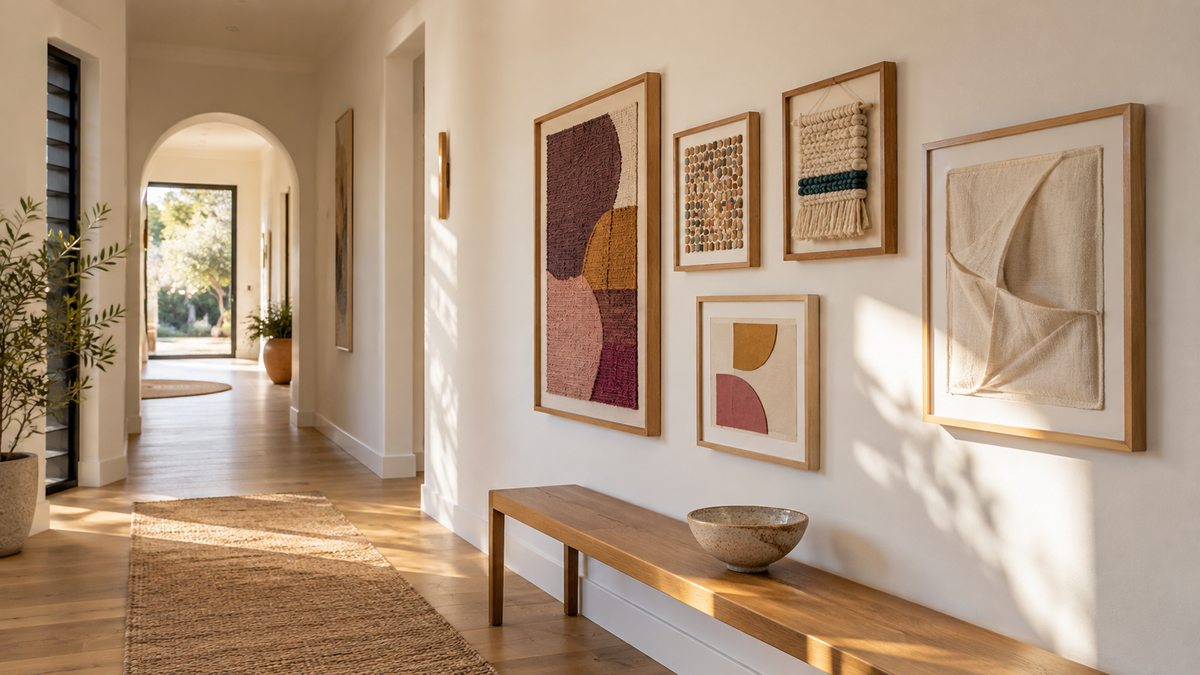
To display handmade art without making a room feel cluttered, choose one clear display zone, leave generous space around each piece and repeat one or two visual elements such as frame colour or alignment. Not every finished project needs to be visible at once. A small, edited group can give each piece more presence—and make it easier to rotate new work in later.
Begin with one place, not the whole house
A hallway wall, the space above a sideboard or a quiet corner can become a natural home for handmade work. Starting with one zone keeps the decision manageable and prevents small pieces from being scattered wherever there is an empty hook.
Look at the space from the doorway or the place where you most often enter the room. Decide what you want the eye to notice first. One larger piece can lead, while smaller works support it. If every item asks for equal attention, the arrangement can feel busy even when there are only a few pieces.
Choose an anchor piece
The anchor is the work that sets the scale and mood for the display. It might be the largest piece, the one with the strongest colour or simply the project that means the most to you. Place it first, then give it room before adding anything else.
Other pieces do not need to match the anchor exactly. They can connect through one colour, a similar material or a shared frame finish. A fabric artwork, dot mosaic and small woven piece can sit comfortably together when one relationship helps the group make visual sense.
If you are still choosing what to make, our guide to selecting a first diamond painting explains how subject, dimensions and display space can guide the project from the beginning.
Use empty wall as part of the arrangement
Negative space is the clear area around and between objects. It is not wasted room. It helps the outline, colour and texture of each handmade piece remain visible.
Before making holes, lay framed work on the floor or trace the frame sizes onto plain paper. Tape the paper shapes lightly to the wall and view them from several steps away. Increase the gaps until the grouping feels calm rather than compressed.
There is no universal spacing measurement because frame size, wall width and viewing distance vary. Consistency matters more than a fixed number: repeated gaps create order, while one deliberately larger gap can separate two visual groups.
Repeat one frame finish
Frames can unify different craft types without making everything identical. Light timber brings warmth, slim black frames create definition, and warm white frames can sit quietly against pale walls. Choose the finish that suits both the room and the work.
If every piece needs a different depth or mounting method, repeat the frame colour rather than the exact profile. A textile may need more space than a flat paper piece. Use a solution suitable for the material and weight; do not press dimensional work into a frame simply to make the group uniform.
Unframed work can also belong in the display. A hanging ornament or small woven piece may provide texture between flatter works. Keep the hanging method simple so the material remains the focus.
Build a palette from the room
A display often feels settled when it shares two or three colours with the surrounding room. Those connections can be subtle: the plum of a cushion, the teal of a ceramic piece or the warm timber already used in furniture.
You do not need to remove every colour that falls outside the room palette. A single contrasting work can become the focal point. If several pieces are competing, repeat the contrast once in a smaller work or accessory so it feels intentional.
For a simple way to identify anchor, support and contrast shades, see our guide to choosing a craft colour palette.
Mix sizes, but keep an invisible line
Different sizes make a display feel collected rather than purchased as a set. The group will still feel organised when the pieces share an invisible alignment.
You might line up the lower edges, centre everything along one horizontal line or build outward from the anchor in a loose rectangle. Choose one organising idea and let the individual shapes vary within it.
Check the arrangement at the height from which it will normally be viewed. A hallway grouping may need a different centre point from work displayed above a low bench. Consider the people and furniture that use the space rather than following a single decorating rule.
Give small projects their own moment
Small handmade pieces can disappear when placed beside many unrelated objects. Instead of filling an entire shelf, create one contained vignette: a small framed work, a low bowl and open space around both.
A shallow picture ledge can hold several small pieces while keeping them off a crowded surface. It also makes rotation easier. Check that the ledge and wall fixings are appropriate for the combined weight and keep fragile pieces away from edges where they may be knocked.
Rotate rather than accumulate
Your home does not need to show every project at the same time. Store clean, dry pieces carefully according to their materials, then rotate them with the seasons or when you finish something new.
A rotation gives familiar work fresh attention and prevents the display from expanding indefinitely. Keep a photograph of arrangements you liked, including approximate gaps, so you can recreate them later without beginning from zero.
Seasonal work can have a defined window rather than competing with permanent pieces all year. When it comes down, replace it with one stored favourite instead of adding another layer to the wall.
Protect the work and the wall
Use hanging hardware rated for the object’s weight and suitable for the wall material. If you are unsure about fixings, seek advice before hanging a heavy frame. Keep works away from places where steam, splashes or frequent contact may affect the material.
Strong direct sunlight can change some colours and materials over time. Follow any material-specific care information supplied with the project, and choose a position that balances visibility with sensible protection.
Frequently asked questions
How many handmade pieces should I display together?
There is no fixed number. Begin with one anchor and two supporting pieces. Add another only if the group still has clear space and a reason for the new piece to be there.
Do all the frames need to match?
No. Repeating one element—such as timber tone, frame colour or mat colour—is usually enough to connect different profiles and depths.
Can I mix different craft types on one wall?
Yes. Connect them through colour, spacing, frame finish or alignment. Check that each material has an appropriate mounting method.
What should I do with projects that are not displayed?
Store them clean and dry using care suited to the material. Label or photograph them so they are easy to rotate back into the room later.
Where can I find another project for my display?
Browse the current OpenClip Crafting collection and choose by the finished piece, available space and process you would enjoy—not by how much wall you feel you need to fill.
A calm display is less about owning fewer handmade pieces and more about showing them with intention. Choose one zone, let an anchor lead, repeat a visual detail and leave enough open space for the work to breathe. The rest can wait for its turn.