
14 September 2026
How to Collect Pickleballs Efficiently After Practice
By OpenClip
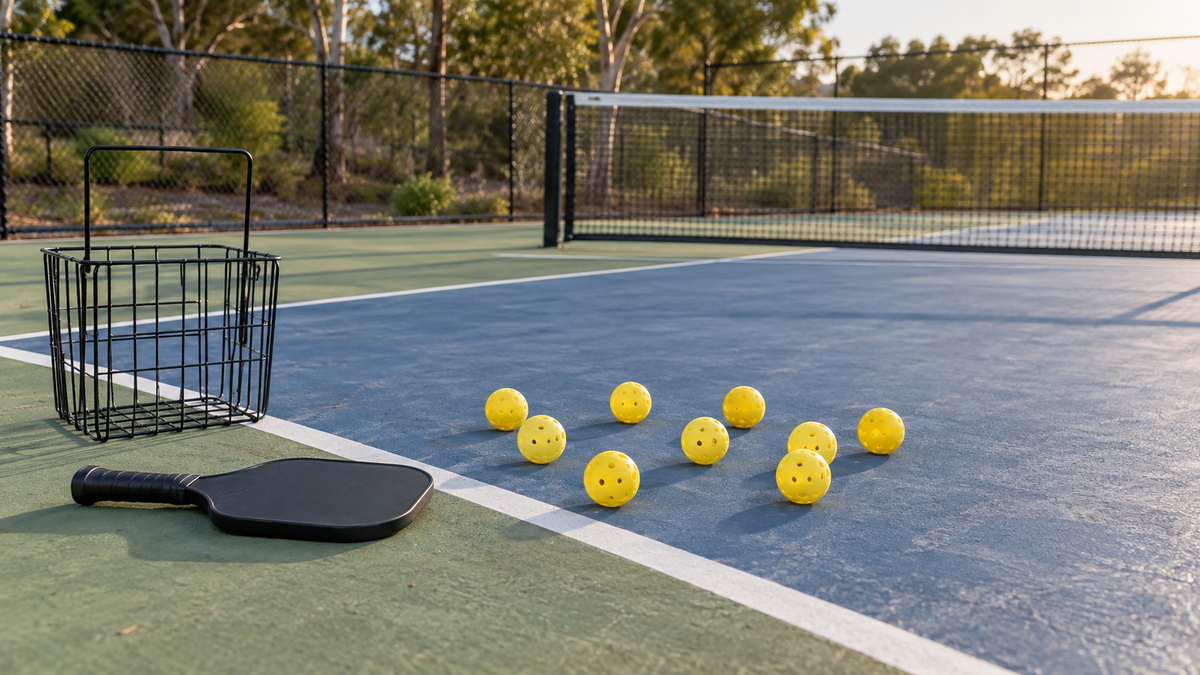
Collect pickleballs more efficiently by keeping each drill to a manageable batch, directing loose balls into one court zone, and using a compatible paddle-mounted ball picker for individual pickups. Fit the silicone cup securely over the paddle’s end cap, press lightly onto one ball, lift it and remove the ball by hand. Always check paddle compatibility before play.
Why ball collection affects a practice session
Multi-ball drills are useful because they let you repeat the same serve, return or dink without stopping after every shot. The trade-off comes when the court fills with loose balls. If every repetition sends balls in a different direction, the clean-up break becomes longer and the next drill takes more effort to organise.
A better collection routine begins before the first ball is hit. Decide how many balls belong in one batch, where the basket will stay and which part of the court will become the collection zone. The goal is not to rush. It is to reduce unnecessary wandering and make each reset predictable.
Set up the court before the first drill
Place your basket outside the active playing area, close to the baseline or sideline you will finish near. Keep spare balls together rather than leaving them along a walkway. If you are practising with another person, agree on who feeds, who hits and who calls the reset.
Start with a smaller batch than you think you need. Six to ten balls can be enough to establish the drill pattern without covering the whole court. Once your feed and target area become consistent, add more only if the extra repetitions improve the session.
For outdoor practice, use balls intended for the playing conditions. The guide to choosing outdoor pickleballs for Australian social play explains what to check before adding a ball pack to your court bag.
Create one collection zone
Where practical, aim each drill towards a defined target area. A cross-court dink drill naturally gathers many balls near one side of the kitchen. A serving drill can use one receiving box. You will still have stray shots, but most balls should finish within a smaller section of court.
At the end of the batch, pause play completely. Move obvious stray balls towards the main zone with the paddle face only when the court is clear and nobody is still hitting. Then collect from the outside of the group towards the basket so you do not repeatedly cross the same ground.
How the Pickleball Ball Picker works
The Pickleball Ball Picker is a compact black accessory made from flexible silicone. It fits over a compatible paddle-handle end cap. The current listed size is approximately 7.4cm across the base and 6.4cm high.
To collect one ball:
- Confirm the silicone cup is seated securely over the paddle end cap.
- Hold the paddle by its grip with the picker facing the court.
- Position the cup directly over a stationary pickleball.
- Press down lightly until the cup grips the ball.
- Lift the paddle and remove the ball from the cup by hand.
- Place the ball in your basket or next-drill position.
Use light pressure only. The accessory is designed to grip one ball for pickup; it is not a scoop, striking surface or permanent paddle modification.
Check compatibility before taking it to court
The picker does not fit every paddle. Handle end caps vary in width, contour and material, and an overgrip can change the effective size. Compare the picker’s approximate dimensions with your paddle before ordering, then check the fit at home before beginning a session.
The silicone should sit securely without forcing it over the handle. If it slips, obstructs your normal grip or does not seat evenly, remove it rather than trying to hold it in place during play. Recheck after changing an overgrip because the end of the handle may no longer have the same profile.
Use a repeatable drill-and-reset rhythm
1. Hit one planned batch
Keep the drill running until the chosen batch is complete. Avoid stopping to retrieve one ball unless it creates an immediate obstruction or the court needs to be cleared.
2. Call the reset
Make sure everyone has stopped hitting before anyone walks into the ball area. A clear verbal reset is especially useful in a shared session where one player feeds from a basket.
3. Consolidate the outliers
Begin with balls furthest from the basket and work in one direction. Do not zigzag between the same two court zones. If two people collect, split the court rather than following each other.
4. Pick up and count
Use the paddle-mounted picker for individual balls, remove each ball by hand and return it to the basket. A quick count helps identify a ball near the fence or on an adjacent court before the next drill begins.
5. Restart from the same position
Return the basket to its marked spot and begin the next batch. Keeping the start point consistent makes the routine easier to repeat and reduces setup decisions between drills.
Solo, partner and family-practice variations
For solo serving practice, put the basket beside the serving baseline and collect from the far corners back towards it. For a two-person feed drill, one player can gather the near half while the other clears the far half. In family practice, use smaller batches and make the reset a clear part of the activity rather than leaving balls around the court.
The simple junior pickleball practice routine offers a separate progression for young beginners. Adults should organise the court and choose equipment appropriate to the player rather than treating a pickup accessory as a toy.
Care and storage
After use, wipe the silicone picker with a damp cloth and allow it to dry fully before returning it to the court bag. Check for damage or a loose fit before the next session. Store it where it will not be crushed beneath heavier equipment.
One ball picker is included in the product package. The paddle, pickleball and basket shown in demonstrations or suggested in this routine are not included. If you are still choosing a paddle, start with the beginner pickleball paddle guide and compare the handle end cap before adding the picker.
Frequently asked questions
Will the Pickleball Ball Picker fit every paddle?
No. Paddle end caps and overgrips vary. Compare the approximate 7.4cm base and 6.4cm height with your paddle, then test the fit before play.
How many balls does it pick up at once?
The product instructions describe pressing the silicone cup onto one stationary pickleball, lifting it and removing the ball by hand. It is not presented as a multi-ball tube or basket.
Do I leave it on the paddle while playing?
Check that the accessory is secure and does not interfere with your grip. If the fit changes, slips or feels unsuitable for normal play, remove it. It is not a permanent fixing.
How should I clean the silicone picker?
Wipe it with a damp cloth and let it dry fully before storing it with your gear. Inspect it for damage before the next practice.
Are the paddle and ball included?
No. The current package includes one Pickleball Ball Picker. The paddle and pickleball are not included.
Make the reset part of the drill
The simplest system is also the easiest to repeat: limit the batch, gather balls into one zone, clear the court in one direction and return the basket to the same place. If a compatible paddle-mounted pickup suits that routine, review the dimensions and current details on the Pickleball Ball Picker product page.