
2 September 2026
How to Choose Outdoor Pickleballs for Australian Social Play
By OpenClip
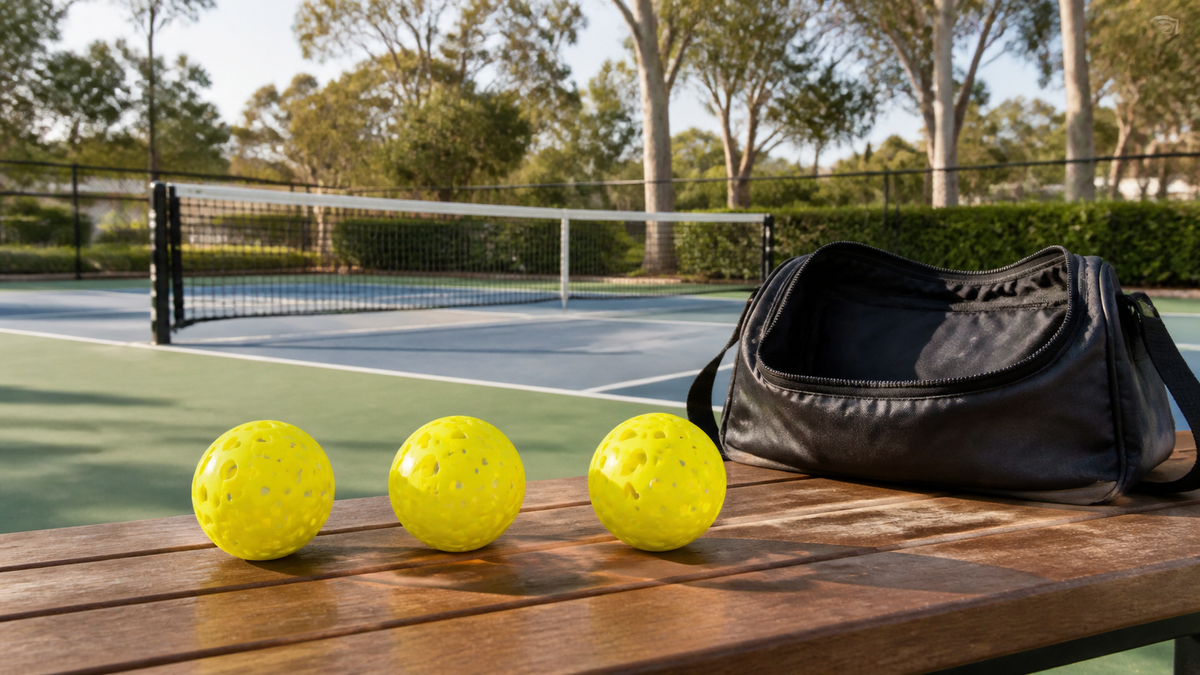
Choose outdoor pickleballs by checking the ball type, visibility, condition and suitability for your court rather than relying on colour alone. For an Australian social session, a high-visibility yellow 40-hole outdoor ball is a practical starting point, and carrying several matching spares helps the group keep playing when a ball becomes cracked, misshapen or difficult to track.
What makes a practical outdoor pickleball?
A useful social-play ball should be intended for outdoor use, easy for the group to see and consistent enough that players are not changing to a noticeably different ball every few rallies. The current OpenClip Outdoor Pickleballs 6 Pack is a high-visibility yellow, 40-hole outdoor option supplied as six matching balls.
| Check | What to look for | Why it matters |
|---|---|---|
| Intended use | Clearly identified as an outdoor pickleball | Matches the product to the court setting |
| Visibility | A colour players can track against the court and background | Supports easier visual pickup during rallies |
| Hole pattern | Evenly formed holes without splits or rough damage | Makes inspection straightforward |
| Shape | Round, not flattened or visibly warped | Avoids starting with an obviously damaged ball |
| Supply | Matching spares from the same set | Lets the group replace a damaged ball promptly |
Start with the court and background
Visibility is contextual. A ball that stands out on a blue or green court may be harder to see against bright signage, dry grass, afternoon glare or a busy fence line. High-visibility yellow is a useful general choice, but the group should still assess the actual venue.
Before the first game, place the ball near the baseline and net, then view it from both ends. If several players struggle to track it, adjust court position, lighting expectations or ball colour where the venue allows. Do not wait until a fast rally to discover that the background hides the ball.
Why bring more than one ball?
A six-ball set gives a social group a working supply rather than a single point of failure. One ball can be in play, a few can stay ready at the sideline and the remainder can remain protected in the bag.
This does not mean all six need to be scattered around the court. Loose balls can become a trip hazard. Keep spares together outside the playing area and retrieve stray balls before restarting the rally.
Matching spares also make changeovers less distracting. When a ball develops a crack or obvious shape problem, the group can select another from the same set rather than borrowing an unknown ball with a very different feel.
Inspect every ball before play
A quick check takes only a few seconds:
- Look around the full surface. Check for cracks, splits around the holes or deep impact marks.
- Check the shape. Rotate the ball in your hand and look for flattening or obvious warping.
- Feel the holes carefully. Stop using the ball if damaged plastic creates a sharp edge.
- Roll it on a flat surface. A visibly irregular path can indicate that the ball is no longer round.
- Agree as a group. Replace a ball when its condition is distracting or questionable.
A cosmetic scuff is different from structural damage. The aim is not to discard every marked ball; it is to identify cracks, sharp edges and meaningful shape changes before they interrupt play.
Use one ball long enough to judge it
Constantly swapping balls makes it difficult to settle into a session. Once the group has chosen an undamaged ball, use it for normal play until there is a clear reason to change.
If players are comparing balls, keep the test simple. Use the same court, similar rally pace and the same paddles. Personal impressions about sound, feel and pace are subjective, so avoid turning a social warm-up into an unsupported performance test.
Store outdoor balls away from avoidable stress
After the session, count the balls, wipe away loose dust with a soft dry cloth and return them to a clean compartment. Do not force them under shoes, drink bottles or heavy equipment that can press them out of shape.
Avoid using a hot parked car as long-term storage. Keep the set indoors, dry and away from prolonged direct sunlight when it is not being used. Do not apply solvents or harsh cleaners unless the product instructions specifically approve them.
Your paddle needs a similar reset. See how to clean and care for a raw carbon pickleball paddle after an outdoor session.
Match the ball supply to the group
For a casual two-player hit, several spares can remain in the bag. A larger rotating group may prefer to place one or two balls at each end outside the playing area, provided they cannot roll onto the court.
The OpenClip product is sold as a 6 Pack, which can support an ordinary social session without claiming a fixed number of games or a guaranteed lifespan. Ball life depends on use, impacts, storage and conditions, so inspect rather than relying on a calendar.
Do paddles change which ball you need?
The venue and play setting should determine the ball first. Paddle construction can change the player's perception of contact, but it does not turn an indoor ball into an outdoor one or remove the need to check condition.
If you are also selecting equipment, read our beginner pickleball paddle guide and the comparison of control versus power paddle responses. The current OpenClip T700 2-Player Bundle provides two paddle choices, while balls remain a separate product.
What this product does not claim
The current Shopify listing verifies a six-ball quantity, outdoor use, 40-hole design and high-visibility yellow colour. It does not currently publish a sanctioned-event approval, laboratory bounce result, wind-performance figure, durability cycle or guaranteed playing life.
For social play, that means the most reliable approach is practical: confirm the venue accepts the ball, inspect each one, keep matching spares ready and replace a ball when its condition is no longer suitable.
Frequently asked questions
How many balls are in the OpenClip outdoor set?
The current product contains six high-visibility yellow outdoor pickleballs.
How many holes does each ball have?
The current Shopify product listing and tags identify the OpenClip outdoor ball as a 40-hole design.
Why choose a high-visibility yellow ball?
Yellow can provide strong contrast on many outdoor courts, but visibility depends on the surface, background and light. Check the actual venue with the players who will use it.
When should an outdoor pickleball be replaced?
Replace it when it is cracked, has a sharp damaged edge, is visibly warped or no longer feels suitable to the group. Light cosmetic scuffs alone do not always mean structural failure.
Are OpenClip outdoor pickleballs approved for sanctioned tournaments?
OpenClip does not currently advertise this 6 Pack as approved for sanctioned tournament play. Check the event's current approved-equipment list and rules before competition.
Choose a consistent set and check it every session
A practical outdoor ball is visible, undamaged and appropriate for the court. Keep matching spares safely off the playing area and inspect them before each session. Review the current OpenClip Outdoor Pickleballs 6 Pack when building a simple social-court kit.