
29 September 2026
Can Crafting Together Help People Feel More Connected?
By OpenClip
Research suggests shared making can support conversation, belonging and repeated social contact, but it does not guarantee friendship or treat loneliness. Here is what knitting and expressive-arts studies found—and how to make a gathering more welcoming.
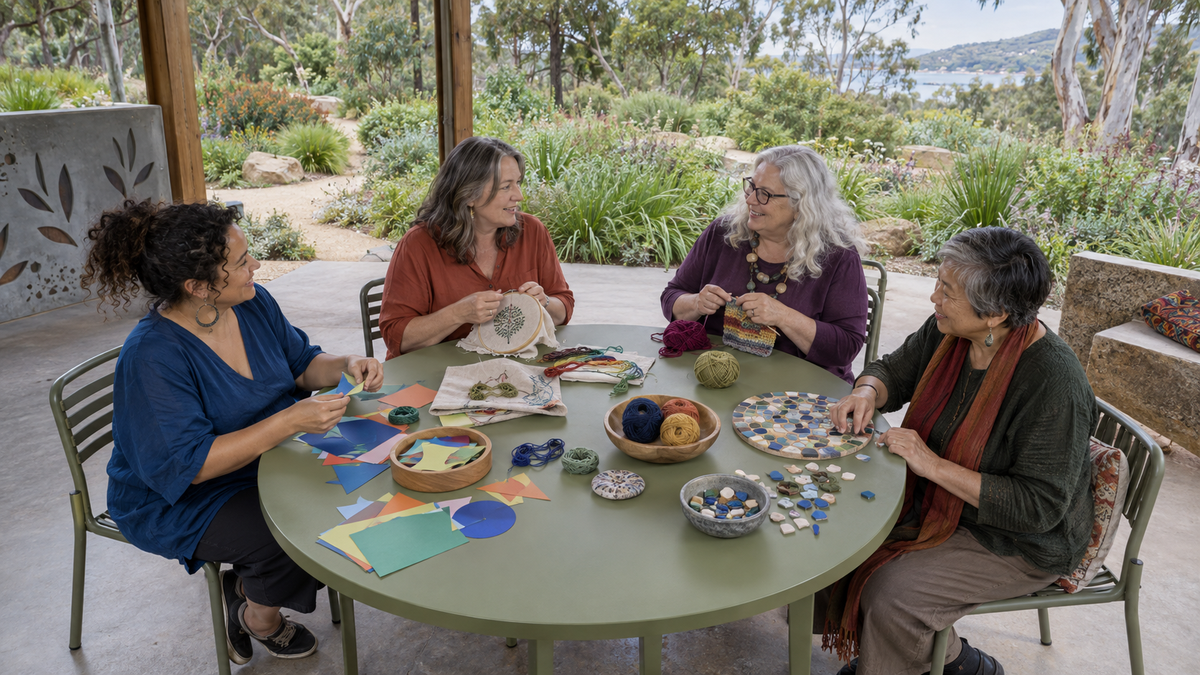
Can crafting together help people feel more connected? Research suggests that shared making can create useful conditions for conversation, belonging and repeated social contact, but the evidence is mostly observational or qualitative. A craft group is not automatically inclusive, and making is not a treatment for loneliness. The practical value comes from a shared activity, a welcoming structure and room to participate at your own pace.
What the research can—and cannot—tell us
Studies of knitting groups, expressive arts programmes and online making communities often describe connection, conversation and belonging. That is meaningful, but much of the research asks people to report their experiences or closely observes a small group. These designs can show how and why a gathering feels valuable; they usually cannot prove that the craft itself caused a lasting change in someone’s social life.
The type of making also matters. Findings about knitting should not be treated as proof for every craft, every group or every person. A structured programme with trained facilitators is different from four friends meeting at home.
A large knitting survey found an association with social contact
A 2013 international survey examined the personal and social experiences of adult knitters recruited through an online knitting community. Respondents were mainly white women and frequent knitters. People who knitted in a group reported perceived benefits for happiness, social contact and communication.
The survey included both quantitative and qualitative information, but it was cross-sectional and drew from a self-selected community. It cannot establish that group knitting caused those outcomes. People who already enjoy groups, knitting or online craft communities may be more likely to participate and respond.
Its useful contribution is narrower: for many respondents, knitting was not only a solitary task. It also provided a shared interest around which contact and conversation could happen.
Making side by side may change the rhythm of conversation
A 2021 study assessed “knit and natter” focus groups as a research method, particularly with older women. The researchers reported that the familiar, repetitive activity contributed to feelings of connectedness and supported detailed conversation. Participants could talk while their attention moved between the discussion and the work in their hands.
This was a methodological study, not a trial of a craft programme. Its findings describe what happened in those focus groups rather than a guaranteed effect of knitting. The paper also identified an important complication: skill differences and established group dynamics could make someone feel they did not belong.
That tension matters. A shared activity can give a conversation structure, but the people and rules of the group determine whether the space feels open.
A small expressive-arts programme centred relationships
A Canadian participatory study paired eight socially isolated older adults in rural communities with eight older volunteers. The pairs completed expressive arts over ten home visits. Through logs, evaluations, field notes and creative work, the researchers reported perceived benefits involving relationships, personal development and meaning for participants and volunteers.
The programme was small, intentionally designed and involved one-to-one pairs rather than an informal craft circle. It offers a detailed example of relationships developing around shared creative activity, not a general estimate of how often this happens.
Why a shared project can make meeting easier
The studies point to several plausible social features of making together:
- A ready topic: materials, colours and next steps provide natural conversation starters.
- Comfortable pauses: silence does not need to mean the conversation has failed; everyone still has something to do.
- Visible exchange: people can share a technique, admire progress or ask for a practical opinion.
- A reason to meet again: an unfinished project or regular session can provide continuity.
These are interpretations of how shared activity may support interaction, not medical outcomes. Some people prefer to make alone, and a group can be tiring, distracting or simply not enjoyable.
How to make a craft gathering genuinely welcoming
Choose a project with several valid versions
A good social project does not require everyone to copy one result. Offer a simple shared format with room for different colours, designs or levels of detail. People can see that variation is expected rather than evidence that someone is doing it incorrectly.
Make skill optional, not a condition of entry
Say clearly whether beginners are welcome and what support is available. Avoid turning one experienced maker into an unpaid teacher for the entire session. A short demonstration, printed instructions or a simple first step can reduce pressure on everyone.
Let conversation be optional too
People may join because they want company without constant talking. Side-by-side making allows someone to listen, contribute occasionally or focus on the project. Do not treat quiet participation as a problem to fix.
Keep the first meeting contained
A clear start and finish time makes the invitation easier to accept. Ask people to bring a current project, or choose one activity that can pause cleanly. Our practical guide to hosting a relaxed craft night covers the table setup, invitations and pace.
Create more than one way to belong
Not every connection needs to happen in a large in-person circle. Two people can work together, an online call can accompany separate projects, or friends can exchange progress photos between sessions. The best format is the one participants can and want to use.
Choosing a project for shared making
Look for clear stages, manageable materials and a natural stopping point. If people have different experience levels, several individual projects may work better than one collaborative object. Everyone keeps ownership of their pace while still sharing the occasion.
Browse the current OpenClip Crafting collection by the process each person would enjoy. Mention or buy only a specific kit after checking its current product page, selected design, contents and any tools that need to be supplied separately.
Frequently asked questions
Is crafting together proven to reduce loneliness?
No. Studies describe associations and participant experiences involving contact, belonging and relationships, but the evidence does not prove that any craft group will reduce loneliness for everyone.
Does the group need to work on the same craft?
No. A common meeting time may be enough. Different projects can reduce comparison and let each person choose a process suited to their experience.
What if someone is completely new?
Choose a short first step, explain that different results are expected and provide instructions without making expertise the price of joining.
Can an online craft session still feel social?
It can for some people. Online knitting research describes shared identity and belonging, but experiences vary. Keep the technology simple and allow participation without constant speaking or camera use.
Is a craft group a substitute for professional support?
No. A craft gathering is a social or creative activity, not treatment. Anyone needing mental-health or crisis support should seek appropriate professional help.
Research referenced
- Riley, Corkhill and Morris, “The Benefits of Knitting for Personal and Social Wellbeing in Adulthood”, British Journal of Occupational Therapy (2013). Read the study record.
- Harrison and Ogden, “‘Knit ‘n’ natter’: a feminist methodological assessment of using creative ‘women’s work’ in focus groups”, Qualitative Research (2021). Read the study.
- MacLeod and colleagues, “Connecting Socially Isolated Older Rural Adults with Older Volunteers through Expressive Arts”, Canadian Journal on Aging (2016). Read the PubMed record.
The evidence does not say that making together creates friendship on command. It suggests something more practical: a shared creative task can offer a comfortable structure for contact. Keep the invitation clear, the skill threshold low and the conversation optional, then let connection develop in its own way.