
9 August 2026
Vacuum Sealing Food: Benefits, Safety and Practical Tips
By OpenClip
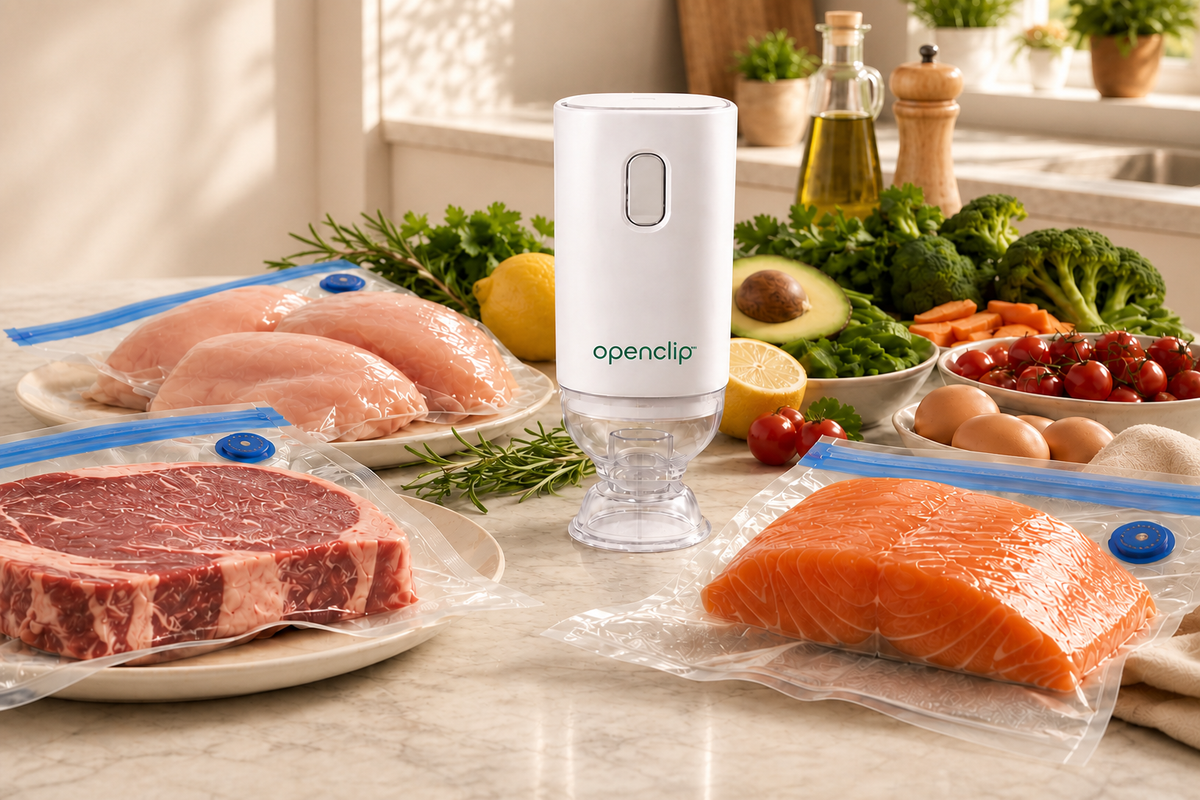
Vacuum sealing removes most of the air surrounding food before its bag or container is closed. For Australian households, it can be useful for portioning bulk purchases, organising meal prep and protecting frozen food from air exposure. However, vacuum sealing does not sterilise food, stop every type of bacterial growth or replace refrigeration and freezing.
What is vacuum sealing?
Vacuum sealing is a storage method that removes air from around food and closes it inside compatible packaging. Reducing the amount of air can limit exposure to oxygen and moisture movement, but the result depends on the food, packaging, seal quality, storage temperature and how the food was handled before sealing.
Domestic systems generally fall into three categories:
- Edge sealers draw air from a specially designed bag before heat-sealing its open end.
- Chamber sealers change the pressure around the entire package and are often larger and more expensive.
- Handheld systems remove air through a valve in a compatible bag or container.
The exact method and compatible packaging vary by product, so always follow the manufacturer’s instructions.
What are the benefits of vacuum sealing food?
The most practical vacuum sealing benefits are better freezer protection, convenient portioning, easier meal organisation and more compact storage.
It can help reduce freezer burn
Freezer burn occurs when frozen food loses moisture and is exposed to air. It affects food quality rather than automatically making food unsafe.
A well-sealed vacuum package reduces the air around food and can help limit dehydration and ice-crystal formation during frozen storage. In comparative household testing, Australian consumer organisation CHOICE found that vacuum sealing performed better than original packaging and a manually de-aired zip-lock bag for protecting frozen chicken from air pockets and freezer burn. Read the CHOICE vacuum-sealer guide.
It makes portioning easier
Bulk meat, cooked meals and other suitable foods can be divided into meal-sized portions before freezing. This makes it easier to defrost only what you intend to use.
Portioning may also help households manage food more deliberately, although vacuum sealing alone does not guarantee that less food will be wasted.
It can support meal preparation
Prepared ingredients or suitable cooked foods can be sealed, labelled and stored for later use. Clear labels are essential: record the food, the sealing date and any original use-by date.
It can improve freezer organisation
Removing excess air can make some packages flatter and easier to stack than bulky containers. The benefit varies with the food and packaging used.
It can protect suitable dry foods from air and moisture
Compatible vacuum storage may help protect suitable dry pantry foods from humidity and air exposure. It must not be treated as a way to make moist, perishable or cooked food shelf-stable at room temperature.
Does vacuum sealing make food last longer?
Vacuum sealing can help preserve the quality of certain foods, particularly in the freezer, but there is no universal shelf-life multiplier.
How long food remains suitable depends on:
- the type and initial condition of the food
- hygiene during preparation
- packaging suitability and seal integrity
- refrigerator or freezer temperature
- whether the food was cooked
- the manufacturer’s storage directions
- the original use-by date
Avoid blanket promises such as “five times longer” unless they are supported by testing that identifies the foods, comparison method, storage temperature and safety criteria.
Most importantly, vacuum sealing is not a substitute for refrigeration or freezing. Food Standards Australia New Zealand advises keeping perishable food at 5°C or colder and following storage and use-by instructions. Read FSANZ food-safety guidance.
Is vacuum-sealed food automatically safe?
No. Removing air does not sterilise food.
Some microorganisms can grow with little or no oxygen. FSANZ identifies improperly processed vacuum-packed foods as a higher-risk category for Clostridium botulinum, the bacterium associated with botulism. Although botulism is extremely rare in Australia, it is serious and requires careful prevention. Read FSANZ guidance on Clostridium botulinum.
Vacuum-sealed food can also be unsafe without displaying obvious spoilage signs. Do not rely only on smell or appearance.
Which foods can be useful to vacuum seal?
Depending on the appliance and its approved packaging, common household uses may include:
- meat or fish portioned for freezing
- suitable cooked meals intended for refrigeration or freezing
- firm cheeses, where supported by the appliance instructions
- suitable dry pantry goods
- meal-prep ingredients
- food prepared for an approved sous-vide process
Food type matters. Liquids, moist foods and delicate produce may require a specific appliance mode, container or preparation method. Do not assume every vacuum-sealing system can safely handle them.
Which foods require extra caution?
Follow the instructions for both the food and the vacuum-sealing system. Australian consumer guidance specifically warns against casually vacuum sealing soft cheeses, fresh mushrooms, onions and garlic because reduced-oxygen storage can create food-safety concerns.
Vacuum sealing should not be used to:
- rescue food that is already deteriorating
- extend food beyond its use-by date
- store perishable food at room temperature
- replace safe cooking, chilling or freezing
- make home-preserved food commercially sterile
- justify using damaged or unsuitable packaging
Discard vacuum-packed food if the package is damaged, bulging, leaking or visibly spoiled. FSANZ specifically advises discarding badly damaged, bulging or spoiled preserved and vacuum-packed food.
How to vacuum seal food safely
Start with clean equipment and sound food
Wash and dry your hands before handling food. Clean benches, utensils and sealing equipment according to their instructions. Vacuum sealing cannot reverse contamination that has already occurred.
Keep raw and ready-to-eat foods separate
Use separate preparation surfaces and utensils where appropriate. Store raw meat, poultry and seafood so their juices cannot contact cooked or ready-to-eat food.
Use packaging that is fit for its intended purpose
Use clean, undamaged, food-safe packaging compatible with the appliance and intended conditions. FSANZ recommends checking whether packaging is suitable for the particular food and for freezing, heating, microwaving, dishwashing or reuse. Packaging designed for one use should not automatically be reused. Read FSANZ food-packaging guidance.
Keep the sealing area clean and dry
Food, liquid or grease across the closure can prevent a reliable seal. Follow the appliance instructions for moist food and liquids rather than improvising.
Refrigerate or freeze promptly
Keep perishable food at 5°C or colder. Do not leave cooked or perishable food at room temperature simply because it has been vacuum sealed.
FSANZ’s general two-hour/four-hour guidance says perishable food left between 5°C and 60°C for less than two hours may be refrigerated again; between two and four hours it should be eaten immediately; and after more than four hours it should be discarded. This time is cumulative.
Label every package
Write down the contents, sealing date, original use-by date where applicable, and any relevant reheating or storage instruction. Vacuum sealing does not reset the food’s age or use-by date.
Check the seal before storage and use
A package that has lost its vacuum, expanded or become damaged should be treated cautiously. When in doubt, discard the food.
Where ClipOne™ fits into an everyday routine
ClipOne™ is OpenClip’s compact cordless handheld vacuum sealer for compatible reusable valve bags. According to OpenClip’s product specifications, it provides -60 kPa suction, charges by USB-C and completes a seal in around five seconds.
The ClipOne Essential Bundle includes:
- 1 × ClipOne cordless vacuum sealer
- 5 × Small reusable vacuum bags measuring 22 × 21 cm
- 1 × USB-C charging cable
- a 60-day satisfaction guarantee
OpenClip positions the system for meal prep, leftovers and freezer storage. Compatible reusable valve bags are available in Small, Medium, Large and XL sizes. Bags should be washed and dried completely before reuse, and appropriate food-storage and food-safety guidance must always be followed.
These are manufacturer-supplied product specifications. They do not establish a universal shelf-life extension for every food.
Is a vacuum sealer worth it?
A vacuum sealer is most useful when its purpose matches your routine. It may be worth considering if you regularly buy suitable food in bulk, divide food into freezer portions, batch-cook meals, experience freezer burn or want flatter freezer storage.
It may offer less value if you rarely freeze food, prefer rigid reusable containers or do not want to maintain specialised bags.
Before choosing a system, check packaging compatibility, food-contact suitability, freezing or heating directions, cleaning requirements, replacement costs, warranty, available storage space and the manufacturer’s food-safety restrictions.
Vacuum sealing FAQs
Does vacuum sealing replace refrigeration?
No. Perishable vacuum-sealed food still requires refrigeration at 5°C or colder or appropriate freezing. Removing air does not make perishable food shelf-stable.
Can bacteria grow in vacuum-sealed food?
Yes. Some bacteria can grow in reduced-oxygen environments. Good hygiene, correct temperature control and appropriate food selection remain essential.
Does vacuum sealing prevent freezer burn?
It can help reduce freezer burn by limiting the air around frozen food, provided the package is suitable and the seal remains intact.
Can vacuum sealing reduce food waste?
It can support portioning, labelling and freezer organisation, which may help households use food more effectively. It does not guarantee waste reduction.
Can vacuum sealing extend a use-by date?
No. Do not use vacuum sealing to override a use-by date or the manufacturer’s storage instructions.
Can all vacuum-sealing bags be reused?
No. Reuse depends on the material, its condition, the food previously stored and the manufacturer’s directions. Do not reuse single-use packaging, and follow the bag manufacturer’s cleaning and food-safety instructions.
A more considered approach to food storage
Vacuum sealing works best as one part of a safe food-storage routine: start with sound food, use suitable packaging, create a reliable seal, label the package and maintain the correct temperature.
For a compact cordless option designed around reusable valve bags, explore the ClipOne Essential Bundle.
Last reviewed: 9 August 2026. General information only; always follow current food-safety and manufacturer guidance.